

// Project Proteo
The economic crisis of 2007-2008 had a direct impact on real estate development worldwide, and the coastal towns of Costa Rica’s Central Pacific, whose growth relied on tourism, were no exception. As a result, Jacó is now home to the tallest abandoned building complex in Central America, Sonesta One.
This complex was 80% completed but never put to use. From an environmental standpoint, this situation is critical as emissions associated with building materials account for 10% to 50% of the total emissions across a building’s lifecycle, and these structures are now nearing demolition without ever having been utilized.
In response, a proposal has been made to repurpose and rebuild the complex to make use of the financial investment and resources already employed. This would allow the 20,000 m² space to address the shortage of higher education infrastructure in the Central Pacific region, extending the building’s life-cycle so that its environmental impact does not go to waste.
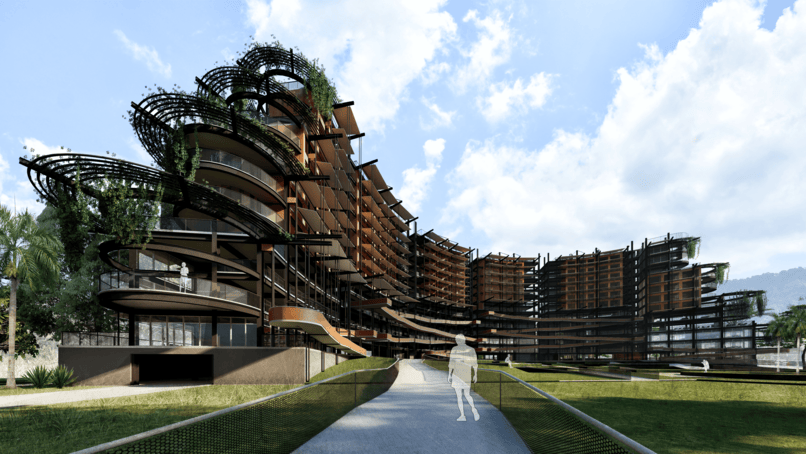

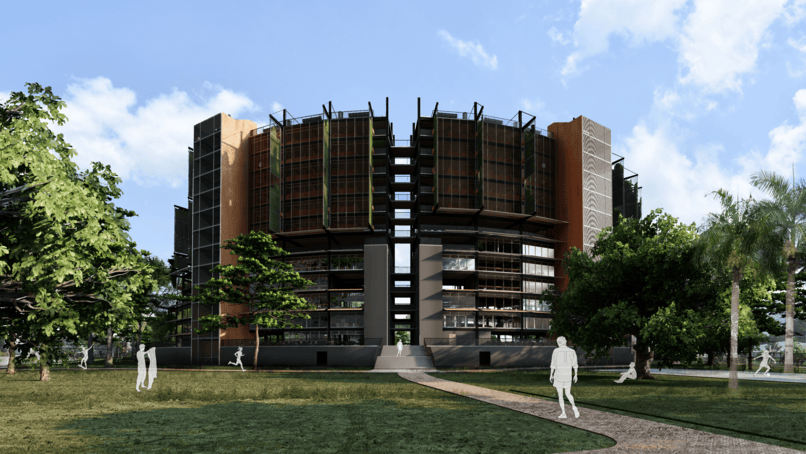
A five-point strategy is proposed to enhance the adaptability of the existing building:
- Reduce it to its “skeleton,” using the existing steel framework.
- Demolish current enclosures (with debris used as filler in the plaza).
- Reprogram the interior with lightweight enclosures for future adaptability.
- Design a multi-layered façade to optimize natural lighting and ventilation, reducing emissions during operation.
- Implement a Canadian well system to minimize air conditioning use, limiting it to spaces that require it based on function.
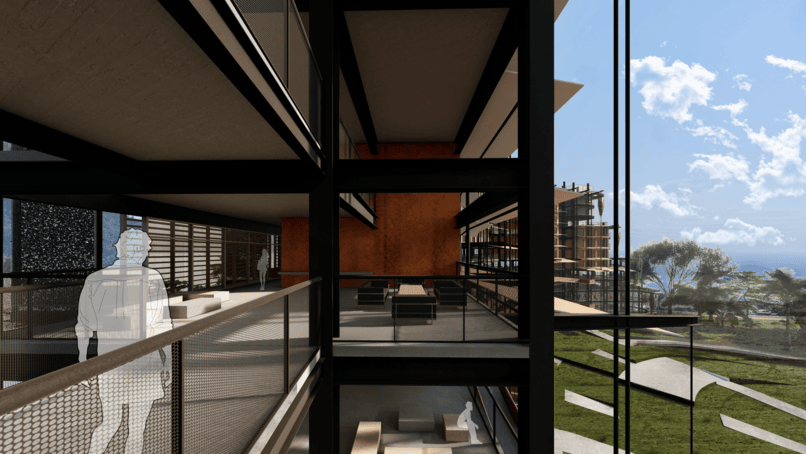
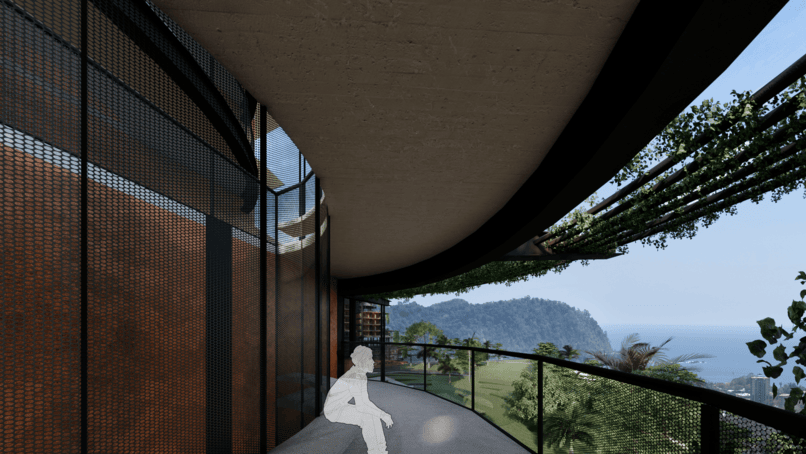
With these optimizations, 64% of the project area will operate with cross-ventilation, 22% will be cooled through the Canadian well ducts, and only 14% of spaces will require traditional air conditioning. Additionally, to offset the energy consumed by air conditioning, solar panels and vertical-axis wind turbines will be installed on the building’s roof.
Project PROTEO not only brings these buildings back from abandonment and addresses the shortage of public infrastructure in the area, but it also represents the first step toward orienting the site’s development toward resilience—creating opportunities for local residents and promoting the conservation of the natural surroundings.